

Built for enterprise AI, regulated data and zero trust environments.
How does Locktera secure AI workflows?
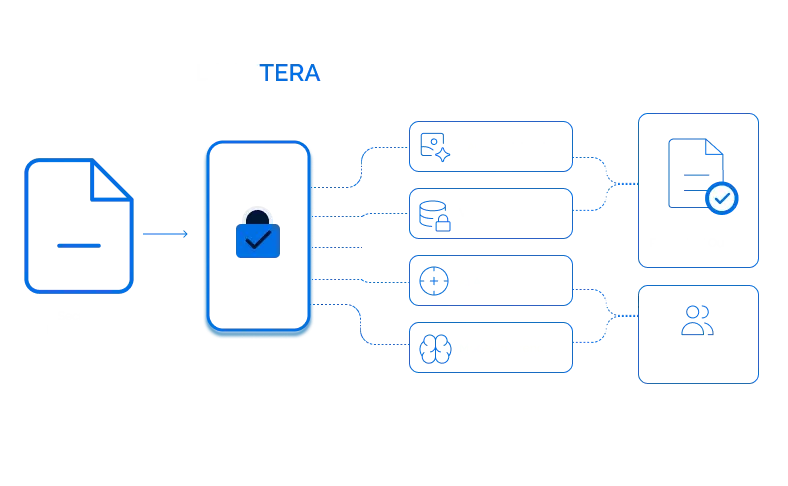
Locktera protects sensitive files before they enter AI systems and maintains encryption, access controls, immutable protection, and audit trails throughout the entire AI lifecycle. Security remains attached to the data—through RAG pipelines, AI agents, vector databases, cloud storage, applications, and AI-generated outputs.

Enterprise Data

Locktera Protection Layer

AI Workflow
RAG · Agents · Models

Protected Output

Authorized Users & Systems
File-Level Encryption
Secure every file with encryption, access controls, immutability, and complete auditability.
Immutable Containers
Protected files cannot be modified, replaced, or tampered with after creation.
Dynamic Access Controls
Control who can access protected files—and revoke access at any time.
Complete Audit Trail
Track every access event, download, policy change, and security action.
AI is Moving Sensitive Data Beyond Traditional Security Boundaries
Enterprise AI systems retrieve, copy, transform, summarize and distribute data across models vector databases, applications, users and thire-party services.
Traditional infrastructure security may protect the system where a file is stored—but that protection does not follow the file once it enters an AI workflow.
Sensitive data can be exposed through:
Enterprise AI systems retrieve, copy, transform, summarize and distribute data across models vector databases, applications, users and thire-party services.
Traditional infrastructure security may protect the system where a file is stored—but that protection does not follow the file once it enters an AI workflow.
RAG ingestion and retrieval
Vector databases and embeddings
AI agents and automated actions
Model inputs and generated outputs
Temporary processing and staging environments
Third-party models and AI services
User downloads and external sharing
Compromised applications, credentials or infrastructure
AI expands the number of places sensitive information can travel. Locktera keeps protection attached to the data itself.
Protect
Encrypt files before they enter AI systems using client-side, file-level security.
Govern
Apply access rules based on identity, role, organization, time, location and permitted use.
Track
Create a detailed audit trail of access, denials, downloads, policy events and file activity.
Control
Revoke access, expire permissions or block future use without relying solely on the application that recieved the file.
Secure the Entire AI Data Lifecycle

Data enters
the workflow
Files are classified and protected before ingestion. Locktera applies file-level security, immutable packaging, and defined access policies.
AI processes
authorized data
Applications retrieve or decrypt data only when the requesting user, service, or workflow meets the required policy.
Protected outputs
are created
Reports, summaries, images, evidence, and other AI-generated outputs can be protected before they are stored or distributed.

Governance continues
after processing
Access policies, revocation controls, and audit records remain available throughout the file's lifecycle.



Locktera adds persistent data governance without requiring organizations to replace their existing models, storage platforms, or AI applications.
Built for Modern AI Architectures
RAG Workflows
Protect source of documents and enforce authorized access at retrieval.
AI Agents
Control what agents can access, what actions are allowed and how activity is recorded.
Enterprise Copilots
Extend file-level governance into employee facing AI assistants.
AI-Generated Outputs
Protect reports, analysis, images, code and other derived assets.
Data & Model Pipelines
Apply persistent controls across ingestion, enrichment, transformation and distribution.
Designed for CISOs, CTOs and Developers

For CISOs
Reduce data exposure, strengthen zero-trust and create defensible evidence that access policies are being enforced.

For CTOs
Add a reusable data-security layer across AI platforms without trying governance to a single model, cloud or application.

For Developers
Use Locktera Core™ APIs and SDKs to add encryption, access controls, immutable protection and auditability directly into applications.
Can Locktera Protect Existing AI Applications?
Yes. Locktera integrates with existing AI applications, RAG pipelines, AI agents, storage platforms and enterprise workflows through APIs and gateways.
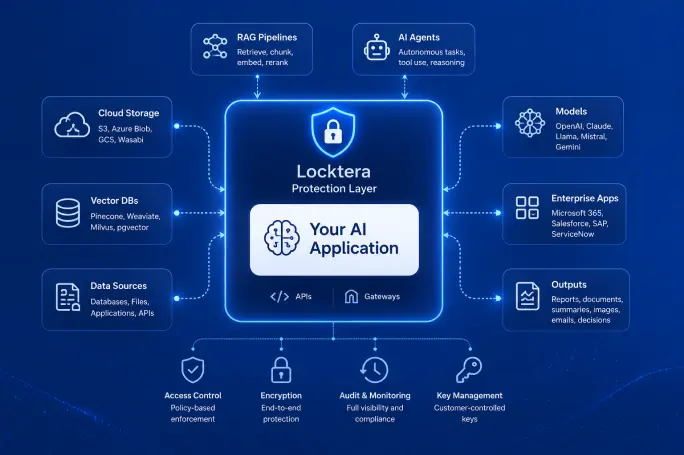
Add persistent security without replacing your AI infrastructure.
Secure AI Workflows for Regulated Industries

Healthcare
Protect patient data, medical images and clinical AI workflows.

Legal
Secure privileged documents, discovery and legal work product.

Financial Services
Govern customer information, AI models and regulated financial data.

Public Sector
Protect sensitive records and AI-enabled government workflows.

Media & Surveillance
Secure images, video, evidence and digital assets end-to-end.
See Locktera in Action
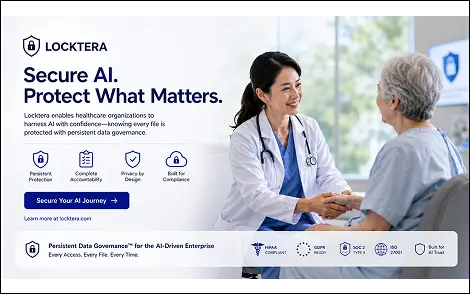
Healthcare AI Story
See how Locktera protects regulated patient information throughout an AI-assisted clinical workflow.
Watch 2-Min DemoGive Enterprise AI a Persistent Data Security Layer
Protect sensitive data wherever AI takes it
Frequently Asked Questions
What are secure AI workflows?
Secure AI workflows protect sensitive information throughout the entire AI lifecycle—from data ingestion and retrieval to model processing and AI-generated outputs. Rather than securing only infrastructure, secure AI workflows apply persistent, file-level security, encryption, access controls, governance policies, and audit trails directly to the data itself.
How does Locktera secure AI workflows?
Locktera applies persistent data governance before files enter AI systems. Files remain protected with file-level security, immutable containers, encryption, access controls, and audit trails as they move through RAG pipelines, AI agents, vector databases, cloud storage, enterprise applications, and AI-generated outputs.
Does Locktera work with existing AI applications?
Yes. Locktera integrates with existing AI applications, RAG pipelines, AI agents, vector databases, cloud storage, enterprise applications, and custom AI workflows through REST APIs, SDKs, and secure gateways. Organizations can add persistent security without replacing their existing AI infrastructure.
Can Locktera secure Retrieval-Augmented Generation (RAG) workflows?
Yes. Locktera secures documents before they are ingested into RAG pipelines and maintains governance throughout retrieval and generation. Authorized AI services can access protected content while audit logs, access policies, and encryption remain attached to the data.
Does Locktera support AI agents?
Yes. Locktera enables AI agents to securely retrieve authorized files while enforcing organization-defined security policies. Access permissions, encryption, download controls, audit trails, and governance remain active throughout AI agent workflows.
Can Locktera protect AI-generated content?
Yes. Reports, summaries, contracts, medical records, images, and other AI-generated outputs can be automatically protected before they are stored, shared, or distributed. Security policies continue to travel with every protected file.
How does Locktera protect sensitive data used by AI?
Locktera encrypts files before they enter AI workflows and applies persistent file-level security that travels with the data. Protection includes encryption, immutable containers, dynamic access controls, audit logging, rights management, and policy enforcement throughout the file’s lifecycle.
What is persistent data governance?
Persistent data governance means security policies remain attached to the file itself instead of depending solely on the storage system or application. Even if files move between AI applications, cloud storage, email, collaboration platforms, or users, governance continues to be enforced.
What types of AI workflows can Locktera protect?
Locktera secures:
- Retrieval-Augmented Generation (RAG)
- AI agents
- Large Language Models (LLMs)
- Enterprise AI applications
- Vector databases
- AI document processing
- Medical AI workflows
- Legal AI assistants
- Financial AI systems
- AI-generated reports and documents
- AI image and video workflows
Does Locktera replace my AI platform?
No. Locktera adds security to existing AI environments without requiring organizations to replace their models, storage platforms, applications, or workflows.
Does Locktera encrypt data before AI processing?
Yes. Files can be protected with client-side encryption before they enter AI workflows. Authorized AI services can securely retrieve or decrypt content only when they meet the organization’s defined access policies.
Can Locktera secure vector databases?
Yes. Locktera protects documents before embedding and indexing while maintaining governance over the original files. Organizations retain visibility, auditability, and control over sensitive information throughout AI retrieval workflows.
How does Locktera control access to AI data?
Administrators can define dynamic policies including:
- User and group permissions
- Time-based access
- IP restrictions
- Geographic restrictions
- Download permissions
- Read-only viewing
- Revocation
- External sharing controls
These policies remain attached to protected files regardless of where they are stored.
Does Locktera create audit trails for AI workflows?
Yes. Locktera generates detailed audit records that can include file access events, policy enforcement, downloads, denied access attempts, sharing activity, and administrative actions. These audit trails support compliance, investigations, and governance requirements.
What industries use secure AI workflows?
Organizations in many regulated industries benefit from secure AI workflows, including:
- Healthcare
- Legal
- Financial Services
- Public Sector
- Media & Surveillance
- Manufacturing
- Energy
- Education
Can Locktera help with AI compliance?
Yes. Locktera helps organizations implement technical controls that support compliance initiatives by protecting sensitive information, enforcing access policies, maintaining audit trails, and improving governance throughout AI workflows. These capabilities can support regulatory and organizational requirements such as HIPAA, GDPR, CCPA, SOC 2, ISO 27001, and AI governance frameworks.
Does Locktera support cloud and hybrid AI environments?
Yes. Locktera works across cloud, hybrid, and on-premises environments. Protected files can remain secure across cloud object storage, enterprise applications, AI services, backup systems, and distributed workflows.
Can developers integrate Locktera into custom AI applications?
Yes. Developers can use Locktera CORE™ REST APIs and SDKs to embed persistent data governance, encryption, access controls, immutable containers, audit logging, and rights management directly into AI applications and workflows.
Why is file-level security important for AI?
Traditional security protects infrastructure, networks, and storage systems. AI workflows often move data between multiple applications, models, and services. File-level security keeps protection attached to the data itself, reducing the risk of unauthorized access, uncontrolled sharing, and loss of governance as data moves through AI systems.
Why choose Locktera for AI security?
Locktera extends security beyond infrastructure by protecting the data itself. Organizations can secure AI workflows with persistent file-level governance, immutable protection, encryption, dynamic access controls, comprehensive audit trails, and developer-friendly APIs—without replacing their existing AI infrastructure.
What are secure AI workflows?
Secure AI workflows protect sensitive information throughout the entire AI lifecycle—from data ingestion and retrieval to model processing and AI-generated outputs. Rather than securing only infrastructure, secure AI workflows apply persistent, file-level security, encryption, access controls, governance policies, and audit trails directly to the data itself.